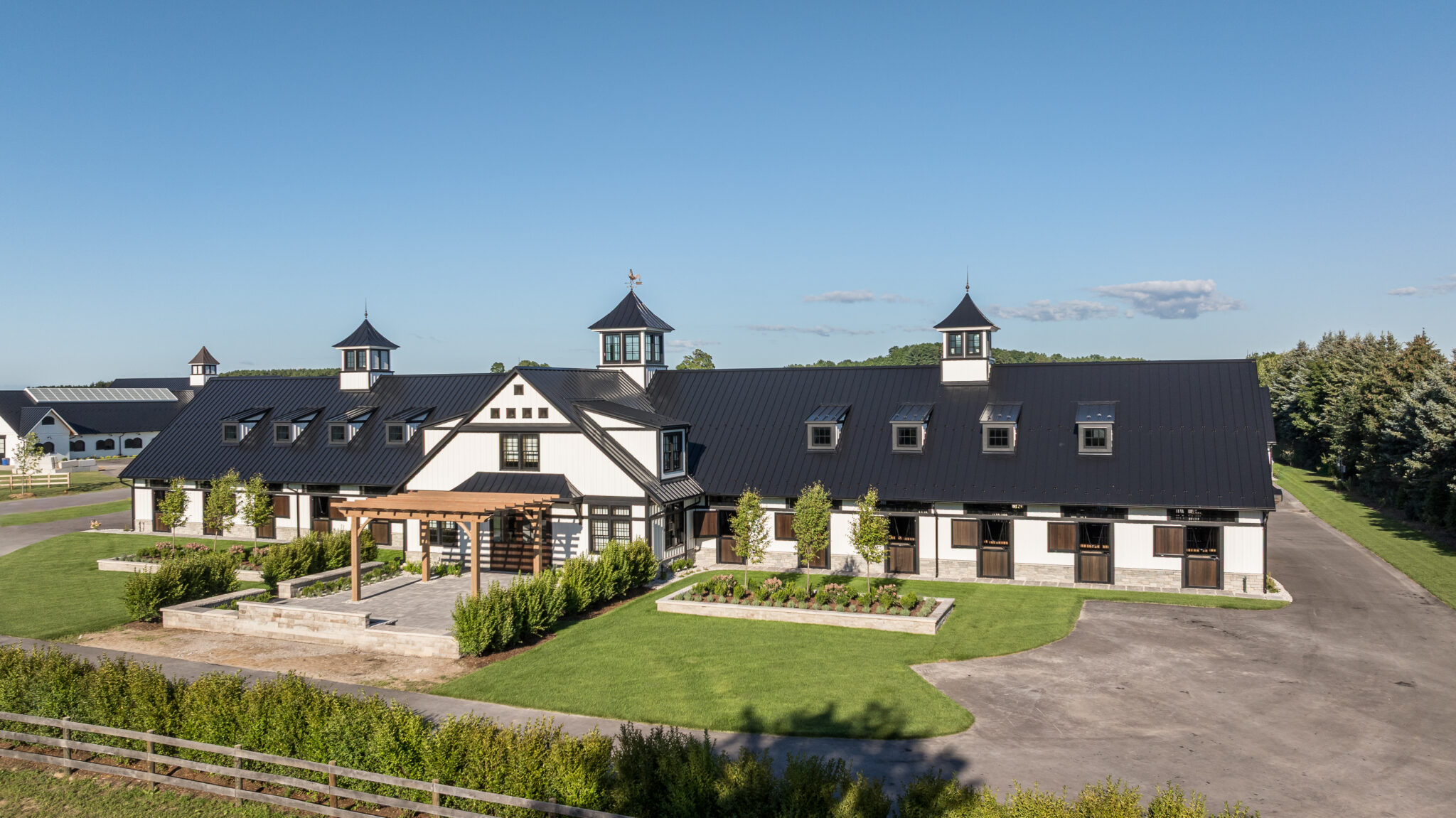
When horse owners purchase land, one of the first major decisions they face is how to create the equestrian facilities of their dreams. For many clients who engage with us at B&D Builders, the question usually comes down to a pivotal choice: Should I build a new luxury horse barn from the ground up, or do I restore and upgrade an existing structure already on the property?
Sometimes the answer is obvious. A collapsing shed or leaning bank barn leaves little room for debate. But in other cases, the choice isn’t so clear. A historic timber barn, a beautifully sited carriage house, or an aging but character-rich gambrel outbuilding can tug at your imagination and make restoration feel not only possible but desirable.
Because this decision has long-term implications for your horses, your budget, and your enjoyment of the property, we’ve created this guide to help you better understand when restoration is the right call, when new construction becomes the smarter investment, and when a hybrid approach combines the best of both worlds.
When It Makes Sense to Restore
Restoration is often the best choice when the existing barn already offers strong fundamentals. In these cases, your investment focuses primarily on performance, modernization, and customization rather than structural rescue.
Signs the Existing Barn Is Worth Restoring
You may be a strong candidate for restoration if:
- The structure has “good bones.”
Straight, true framing, a sound foundation, and a roof that can be repaired or replaced without major reconstruction all point toward a viable restoration. If the skeleton is strong, the rest is typically serviceable. - The building is dry or can be made dry without heroic measures.
Many barns have manageable water issues, able to be fixed through flashing repairs or new drainage solutions, but chronic, severe water intrusion often signals deeper trouble. - The location already works.
If the building sits exactly where you’d want a barn, with a great approach for trailers, an ideal orientation for the wind and sun, scenic views, and logical proximity to riding areas, restoration preserves a siting you might not be able to replicate. - Your program fits within the footprint.
If needs like stall count, aisle width, grooming/wash locations, and tack and feed proximity can be met with smart interior planning rather than invasive structural changes, restoration becomes more efficient. - You value the existing character.
A barn with authentic heavy timbers, stone walls, or historically significant details offers beauty and soul that cannot be recreated affordably. If that authenticity matters to you, restoration honors it. - The budget favors interior upgrades over structural rescue.
When most of your investment goes into stalls, doors, lighting, ventilation, finishes, or functionality rather than shoring up the frame, restoration usually brings the highest return.
Advantages of Restoration
When the baseline conditions are right, restoration offers several meaningful advantages that new construction simply can’t replicate. First, there’s the authenticity of an existing structure, something impossible to manufacture. The patina of seasoned wood, the scale of traditional craftsmanship, and the proportions found in heritage barns create an atmosphere and sense of place that modern buildings rarely achieve.
Restoration also has practical benefits, particularly when it comes to approvals. Because the footprint already exists and neighbors are accustomed to the structure, review processes can often be smoother and faster. Finally, restoration supports sustainability goals by reusing materials and minimizing site disturbance, which helps reduce the overall environmental impact of the project.
Our Golden Rule for Restoration
If structural and water-related repairs total 35–40% or less of what a new building would cost, restoration is often the stronger choice.
When It Makes Sense to Build New
While restoration carries romance and legacy, new construction offers unmatched efficiency and long-term performance, especially when the old structure presents too many compromises.
Signs You Should Build New
Start fresh when the existing structure exhibits:
- Structural red flags.
A racked or sagging frame, widespread rot, insect damage, or failing foundations quickly make restoration cost prohibitive. - Unmanageable water issues.
Chronic leaks, pervasive mold, rotting roof planes, and failed flashing can indicate systemic failure that’s difficult or impossible to salvage. - A footprint that can’t meet your needs.
If you can’t achieve safe stall sizes, proper aisle widths, optimal adjacencies, or arena integration without extensive reengineering, you’ll be fighting the building instead of working with it. - Building code and site constraints that will work against you.
Planning setbacks, fire-access requirements, utility limitations, or historic restrictions may prevent meaningful improvements. - Poor access.
If modern trailer circulation, tractor movement, or service access can’t be resolved with grading or layout changes, a new position and configuration for your barn may be essential.
Advantages of New Construction
Building from the ground up offers several clear advantages that are difficult to achieve through renovation alone. New construction allows you to design a layout tailored exactly to your needs, ensuring that stall counts, aisle spacing, arena connections, expansion zones, and support areas all work together seamlessly. It also enables you to incorporate modern performance features from the very beginning, such as daylighting, ventilation, insulation, fire separation, drainage, and utility routing, all of which can be optimized rather than adapted.
Just as important, new builds support future-proof planning. With clear spans, well-designed service lanes, and scalable configurations, your equestrian facility can grow and evolve without unnecessary friction or costly rework.
Our Golden Rule for New Builds
If required repairs exceed 40% of the cost of a comparable new build, or if you’d still be left with functional compromises, new construction typically protects your investment and elevates day-to-day operations.
When the Middle Ground Makes Sense: Hybrid Solutions
Many properties fall into a middle category, where neither restoration nor new construction will meet all of your needs. In these cases, a hybrid approach often delivers the best blend of performance, value, and character.
When Hybrid Is the Right Choice
A hybrid project makes sense when the existing barn is generally sound and has undeniable beauty or legacy, but your needs have clearly outgrown its footprint, and there’s room for it to grow. In this approach, you’re able to maintain the architectural features that add real character and value while gaining the space and modern functionality your operation requires.
What a Hybrid Project Looks Like
Hybrid design and construction might mean:
- Preserving the historic core.
Elements that carry the barn’s identity — like the center aisle, timber bents, or stone walls — can be restored and remain. - Building a new wing, connector, or indoor arena.
An addition can introduce modern systems and more space for amenities and activities. - Stabilizing and upgrading the envelope.
New construction’s improved roofing, drainage, insulation, and lining allow it to shoulder areas that can be more complex to introduce to older structures, like wash/groom suites, tack rooms, lounges, or mechanical rooms. - Repurposing materials.
Reclaimed beams or boards can be used to create doors, accent features, or pavilion elements, maintaining the barn’s authenticity while achieving modern performance.
Our Golden Rule for Hybrid Solutions
If restoring the shell and adding targeted new space costs roughly the same as a full new build but preserves character and siting advantages that cannot be replicated, the hybrid approach usually offers the highest perceived value.
Your Vision, Our Expertise
Choosing between a restoration, a new build, or a hybrid approach isn’t just a construction decision — it’s a strategic one. The right solution balances heritage, functionality, long-term performance, and cost, creating a space that feels both deeply personal and highly capable.
At B&D Builders, we’ve guided countless clients through this exact crossroads. Whether your property includes a storied timber barn worth preserving, or you’re envisioning a state-of-the-art equestrian facility built from the ground up, our team brings the craftsmanship, expertise, and insight to help you make the right investment for your horses and your land.
If you’re evaluating a property or preparing to design your next equestrian facility, contact B&D Builders. We’ll help you assess your options and create a path that honors your vision. You can also explore our equestrian project gallery to see examples of both restored structures and new luxury barns and arenas, each crafted with care, precision, and our deep appreciation for the equestrian lifestyle.